Safety overview
Safety is a central priority in our project. From the very beginning, we designed all our experiments with a strong focus on protecting both team members and the environment. All laboratory work was carried out under the official biosafety regulations of our host institution, using appropriate containment levels and personal protective equipment. By carefully assessing potential risks and implementing clear safety procedures, we ensured that our research was conducted responsibly, while maintaining the highest standards of scientific integrity and community care.
In our project, we worked with NEB5α and XL10Gold strains of Escherichia coli , which are widely used in teaching and research due to their well-established safety profile. For our eukaryotic experiments, we used HEK293F and HEK293T, commonly employed mammalian cell lines obtained from certified repositories. We also worked with pancreatic cancerous cell lines which were: PANC-1, MiaPaCa-2, BXPC3.
These organisms were specifically chosen because they are considered safe under standard laboratory conditions, and their handling is fully compatible with the biosafety guidelines provided by iGEM and our institution.
To guarantee safe and responsible research, several precautionary measures were implemented throughout our project. All bacterial work was conducted under BSL-1 conditions, while mammalian cell culture experiments were performed under BSL-2 containment, following institutional and iGEM guidelines.
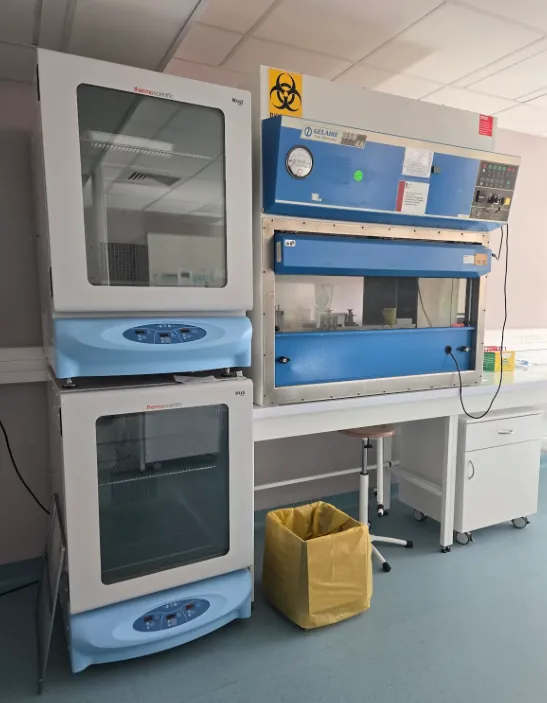
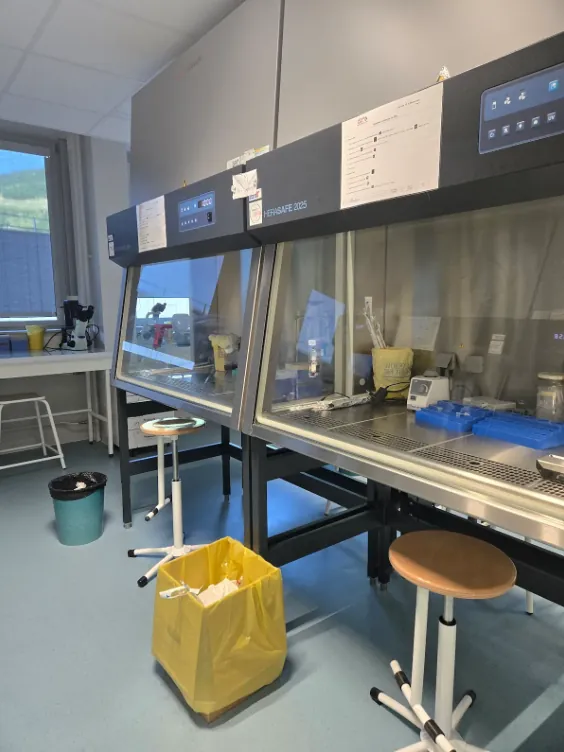
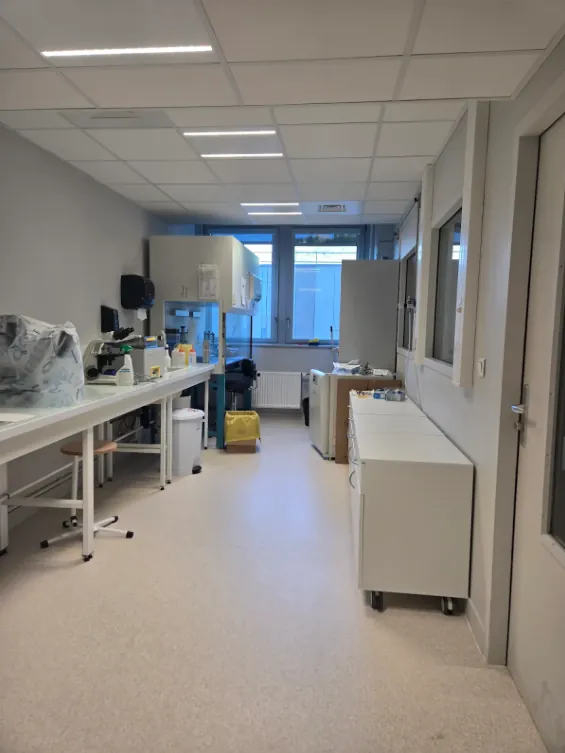
We maintained a strict separation of work areas, with dedicated equipment and biosafety cabinets for bacterial versus cell culture experiments, minimizing any risk of cross-contamination.
Team members consistently used personal protective equipment (EPI) including gloves, lab coats, and protective eyewear and handled samples exclusively under appropriate hoods when required.
For waste management, all biological material was inactivated by chemical disinfection disposal. Finally, every member of the team received formal training in biosafety, waste management, and mammalian cell culture techniques, ensuring that all procedures were carried out according to the highest safety standards. This training takes the form of a health and safety test that biotechnologists must take each year and a formation with the health and safety manager for the engineering team. The formation was attended by the entire team, providing a refresher for the biotechnologists as well.
Safety education
- The health and safety test carried out by biotechnology students covers several topics:
- Basic hygiene rules such as not eating or drinking in practical work rooms and moving around calmly.
- Basic laboratory safety, such as tying back hair, wearing protective clothing, wearing closed shoes, and respecting the different areas of the laboratory. For example, do not mix equipment and products used in the bacteriology area with those used in the cell culture area.
- Correct use of personal protective equipment.
- Correct use of collective protective equipment.
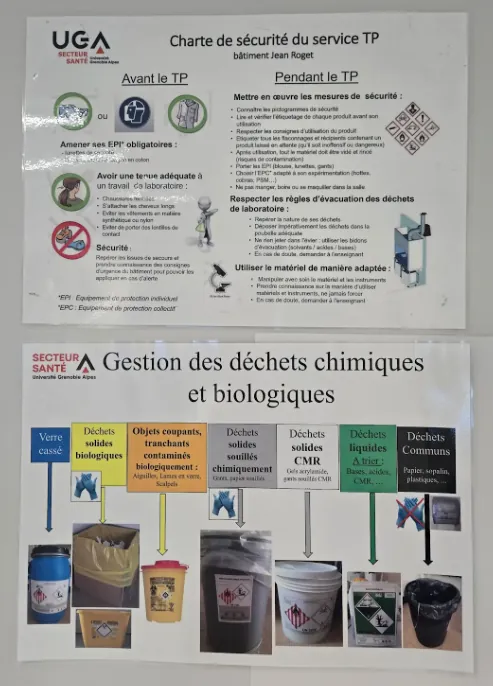
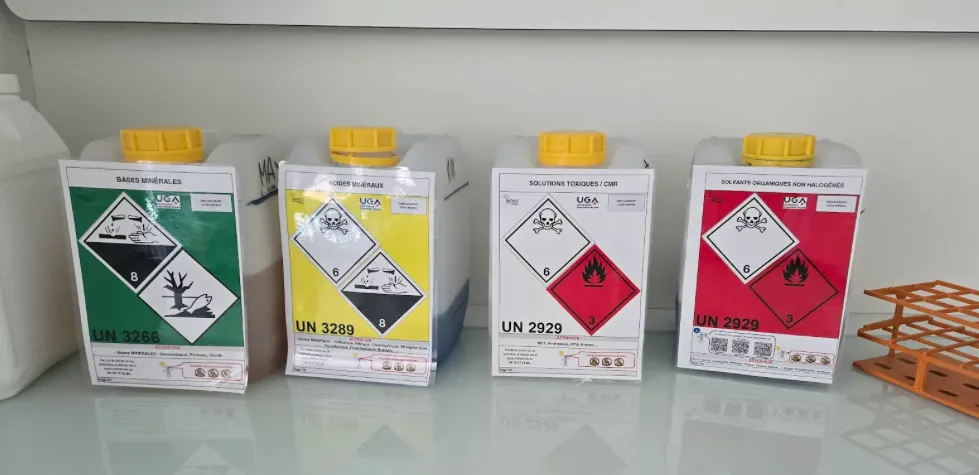
- Sorting of biological and chemical waste and the hazards associated with them.
-
In addition summary sheets detailing the correct procedures for waste sorting are available in all rooms :
Safety of bacteria
- The cCPE fragment is a part of a toxin. However, we only use the non-toxic C-terminal domain (cCPE, residues 194-319), which retains Claudin-4 binding activity but lacks the N-terminal residues responsible for cytolysis.
- cCPE (residues 194-319) does not induce pore formation or cell death, as shown in literature.
- PMC3173885 : "this C-terminal CPE fragment named C-CPE was nontoxic since it lacks the N-terminal regions necessary for CH-1 formation and insertion of CH-1 into membranes to form a pore"
- PMC96936 : "receptor binding activity has been mapped to the extreme C terminus of the CPE protein, and it was shown that C-terminal CPE fragments, such as CPE171-319 (a CPE fragment consisting of residues 171 to 319), are nontoxic"
It may increase drug permeability, which is an intended effect but must be handled responsibly. Moreover, there isn't evidence of pathogenicity or horizontal transfer risks associated with this domain. We will manage any risks as follows: only synthetic, codon-optimized sequences of the cCPE domain will be used, corresponding strictly to residues 194-319.
Bacteria strains
- E.coli NEB® 5-alpha Competent E. coli (High Efficiency) BSL-1
- E.coli XL10 Gold BSL-1
There are risks of contamination in case of ingestion or if the person is immunodeficient.
There are also risks of environmental contamination if the wastes are not properly managed.
Safety of culture cell
- After our protocols reviewing with instructors we could use the following cell lines :
- [BSL-2 : Adenovirus type 5] HEK 293 suspension : HEK-293.2sus - CRL-1573.3 | ATCC Product Sheet
- [BSL-2 : Adenovirus] HEK 293 adherent : 293 [HEK-293] - CRL-1573 | ATCC Product Sheet
- [BSL-1] PANC-1 : PANC-1 - CRL-1469 | ATCC Product Sheet
- [BSL-1] BXPC3 : BxPC-3 - CRL-1687 | ATCC Product Sheet
- [BSL-1] MiaPaCa2 : MIA PaCa-2 - CRM-CRL-1420 | ATCC Product Sheet
Safety of nanoparticles
- Risk related to the RMI contrast agents:
- Gadolinium (contrast agent): due to its toxicity, especially in its ion form Gd(III) and the risk of deposit in several organs of the body.
- Risk related to therapeutic agents:
- Gold nanoparticles : as Gd, Au is highly toxic for the biologic matter. This can be aggravated by the possibility of deposit in important organs such as the brain (because it can cross the blood brain barrier) or the liver. Apart from that it can trigger immune responses, hence undesired inflammatory effects.
- How do we deal with it?
- Gadolinium is used in a chelated complex form to reduce the toxicity (gadoteric acid, same form as they use in hospitals).
- Use of medium sized gold nanoparticles to reduce the risk of cell membrane distortion.
Safety of 3D model printing
- The use of 3D printer and other crafting tools may cause injuries and fire therefore respect the instructions for use of the equipment and room equipped with a fire extinguisher.
- Emission of particles by molten plastic : these particles are highly dangerous for human health when accumulated in great quantities in the air. They can cause irritation of the surface and internal mucous membranes (eye, nose, throat, lungs, etc…).
- To avoid these risks the room is also equipped with a controlled mechanical ventilation. It will be also important to stay outside the room when the machine is running to avoid intoxication. If we need to be in the room, we will use FFP2 masks.
Safety of MRI
- RMI if not used as it should present several hazards for the users. To avoid this danger we will strictly follow the protocol decreed by the laboratory where the imagery will be done.
Safety environment
- The university's policy regarding products used in practical work is as follows: zero waste down the drain!
- This requirement seems obvious, particularly for toxic/CMR products, etc., but in the laboratory we also use more conventional products, such as bleach, which we also use at home and dispose of down the sink.
- However, doing the same thing in the laboratory could have significant consequences for certain systems, as we use much larger quantities.
- To take the example of bleach, water treatment in wastewater treatment plants is carried out in part by bacteria. A massive spill of bleach that reaches these bacteria could have major consequences on water quality and therefore significant environmental consequences.
- Throughout our experiments, we as a team took particular care to sort uncontaminated recyclable waste, whether cardboard or plastic.
- Outside the laboratory, all our travel for iGEM was consciously carried out by carpooling or public transportation in an eco-friendly approach.
- Promoting repair over replacement: During the project, an electroporator broke down. Rather than buying a new device, the engineering team replaced the obsolete components, and the electroporator is now working like a charm.