Contribution to the iGEM Community
- Wet Lab Contribution
- Engineered Therapeutic Strain:
We successfully engineered Lactobacillus to secrete an anti-IL-23 scFv, demonstrating its feasibility as a therapeutic delivery chassis. This construct is deposited as a BioBrick, allowing future teams to directly reuse or modify it for their own therapeutic targets.
- Standardized Protocols and Troubleshooting:
All laboratory methods—including transformation procedures, secretion signal testing, protein detection assays, and activity measurements—are carefully documented. We also include failed attempts and troubleshooting notes, offering future teams practical insights into common pitfalls and alternative strategies.
- Toolkit for Probiotic Engineering:
Our work establishes a toolkit that includes optimized secretion signals, promoter choices, and initial biosafety modules (such as kill-switch concepts). These resources serve as a starting point for any iGEM team exploring probiotic systems, lowering the entry barrier to this field.
- Transparency and Reusability:
Inspired by best practices in quality assurance, we present our experimental data in an open and modular way, so that other iGEM teams can benchmark, replicate, and iterate on our results more efficiently.
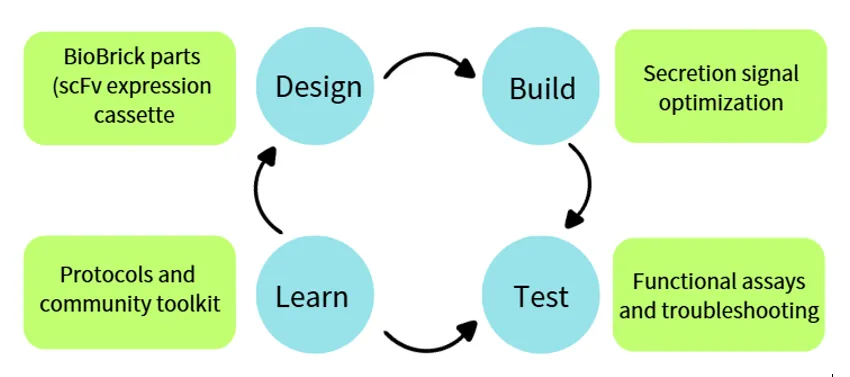
Figure1:wet lab: Design-Build-Test-Learn Cycle and iGEM Contribution
- Human Practices Contribution
- Stakeholder-Driven Design:
Through systematic engagement with clinicians, immunologists, patients, and bioethicists, we integrated real-world perspectives into our project design. Their input highlighted key issues—affordability, safety, accessibility—which directly shaped our focus on oral delivery, modularity, and biosafety.
- Educational Outreach:
We organized science communication activities for high school and university students, introducing synthetic biology through interactive workshops. By using simplified models of engineered probiotics, we inspired the next generation of researchers and fostered broader understanding of living medicines.
- Public Engagement and Awareness:
We developed infographics, social media campaigns, and articles that explain inflammatory bowel disease and probiotic therapeutics in accessible language. These materials are made freely available for reuse by other iGEM teams as outreach tools.
- Framework for Responsible Innovation:
Our Human Practices are not limited to single events; instead, we created a structured process for incorporating feedback and reflecting on societal implications throughout the project. This iterative model of responsible innovation can be adopted by future iGEM teams to strengthen their own HP work.
- Sustainable Community Impact:
By combining outreach, stakeholder dialogue, and open resources, we aim to leave behind not just a project, but a reproducible framework for how iGEM teams can link scientific innovation with human-centered design.
Enhanced Contribution to the Community
In alignment with the transparency, quality assurance, and community-oriented spirit exemplified by institutions like Heidelberg, we commit to contributing beyond our own project’s boundaries. First, we will openly publish and document our design protocols, data sets, and troubleshooting histories under permissive licenses, enabling other iGEM teams to replicate, adapt, and build upon our work. This mirrors how Heidelberg makes its quality assurance procedures, reports, and institutional policies openly accessible, fostering trust and shared learning. Second, we plan to create an interactive knowledge hub or “contribution portal” on our wiki, where future teams can leave feedback, upload derivative designs, report modifications or improvements, and ask questions—thus forming a living community of probiotic-therapeutic development. Third, we will participate in symposia, webinars, and community reviews, presenting our findings and lessons learned (including failures), to help set best practices for engineered probiotic therapeutics. Finally, we commit to long-term maintenance and updates of our contribution materials—just as Heidelberg periodically reviews and updates their web content and institutional policies—to ensure that the tools and knowledge we share remain current, relevant, and useful for successive cohorts of teams.