Project Description
Kuwait’s hot and arid climate poses a major barrier to plant growth. High temperatures, intense sunlight, and sandy soil cause rapid evaporation of irrigation water, leaving little available for plant roots. This threatens agricultural productivity and ecosystem sustainability.
Our team aims to use synthetic biology to address this environmental challenge by designing engineered microorganisms that enhance soil water retention. Rather than relying on chemical soil conditioners or hydrogels, we propose a biological solution that is renewable, biodegradable, and adaptable to the environment.
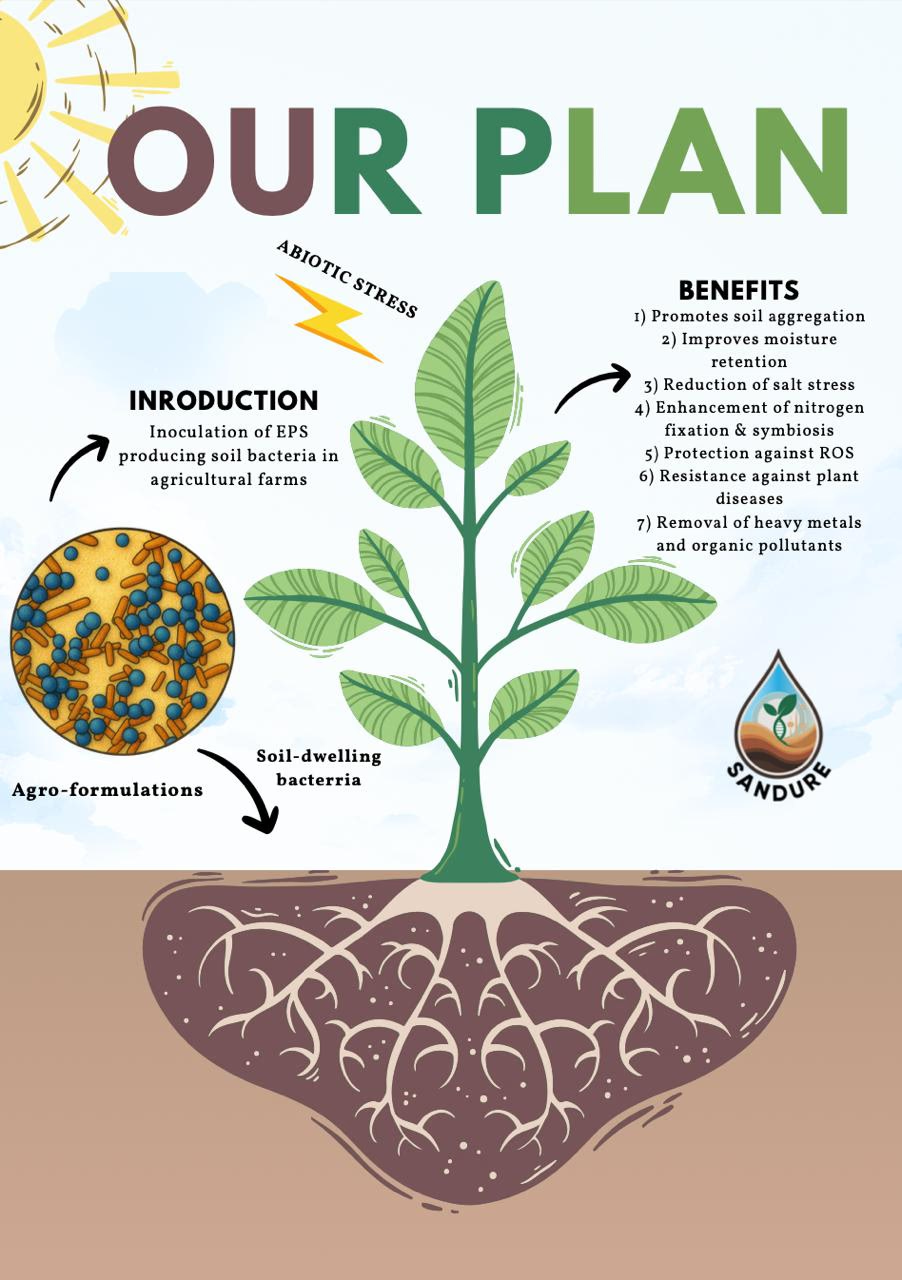
What is EPS?
Extracellular polysaccharides (EPS) are high-molecular-weight polymers secreted by many bacteria. They are composed mainly of sugars such as glucose, galactose, and mannose, forming a hydrated matrix that binds water molecules and improves soil structure.
In nature, EPS plays a crucial role in:
- Biofilm formation.
- Protection from desiccation.
- Soil aggregation and nutrient retention.
We aim to harness this natural by engineering Escherichia coli ATCC 25922 to overproduce EPS, thereby transforming ordinary bacteria into bio-based water retainers or “living hydrogels”.
Our Design
We are using two plasmids: pVanCC and pAcu, to enable and regulate EPS synthesis.
- pVanCC (AmpR): Carries genes responsible for EPS biosynthesis or under activation under specific promoters, possibly encoding enzymes like glycosyltransferases that polymerize sugars into polysaccharide chains.
- pAcu (KanR): Contains regulatory or accessory genes (e.g., transcriptional activators) that complement pVanCC to optimize EPS expression and secretion.
Methods Overview
The experimental process begins with preparing E.coli cells and co-transforming them with both plasmids. After successful transformation, we use antibiotic selection to identify dual plasmid colonies. These colonies are then grown under inducing and non-inducing conditions to compare EPS production. To confirm EPS synthesis, we perform India Ink staining to visualize the capsule-like polysaccharide layer around the cells and a String Test to detect the characteristic viscous texture of EPS. These methods allow us to both qualitatively and quantitatively evaluate EPS production in our engineered strain.
Soil Water Retention Assay
Once EPS production is verified, we test its functional impact on soil water retention. In this experiment, we mix induced and uninduced bacterial cultures into separate soil samples, along with a control containing no bacteria. Each soil sample is then saturated with a fixed amount of water and incubated conditions simulating Kuwait’s desert climate. Over the following days, we measured and recorded changes in soil weight to track water loss through evaporation. By comparing the results, we can determine how much the EPS-producing bacteria improve soil moisture retention compared to unmodified conditions. By comparing the results, we can determine how much the EPS-producing bacteria improve soil moisture retention compared to unmodified conditions.
Biosafety
Throughout this project, we maintain strict biosafety standards to ensure our work is both responsible and safe. Our strain of E. coli is classified as “Biosafety Level 1”, meaning it poses minimal risk to humans and the environment. All biological materials and soil samples are autoclaved or disinfected before disposal to prevent the release of antibiotic resistance genes or engineered cells into the environment.
Impact
Ultimately, our project aims to provide a biological alternative to synthetic soil conditioners, offering a sustainable method for conserving water in agriculture and landscaping. By combining molecular biology with environmental engineering, we hope to showcase the power of synthetic biology to solve real-world problems. Our vision is a future where engineered microbes work alongside nature to help ecosystems thrive, even under the harshest climatic conditions.